Read the earlier posts in this series: Part One or Part Two
POLISH UP YOUR ELEVATOR PITCH
You might think, “What is he talking about? I’m not pitching to venture capitalists!” Doesn’t matter. Every time you meet a person you need to be able to answer the question, “So what do you do?” in a way that is compelling, memorable, and gets your value across. This is where your elevator pitch comes in. To illustrate how the elevator pitch works here is an audio program on the elevator pitch from This American Life. At the least listen to the first ten or so minutes about the MIT contest.
I know the value of a good elevator pitch. I used to introduce myself as, “I am a management consultant.” Think about how many eyes have glazed over at that line! You can imagine in contrast what happens when I say, “I help small business owners get more sleep (and I don’t sell mattresses).” This always invites the question, “How do you do that?” Now I am ready with a brief story that illustrates what happens when business owners work with me.
Use this new marketing campaign elevator pitch as a prompt to revisit the value you are delivering to customers. Keep in mind the principles of FABing: Customers buy Benefits not Features. And, look at how you might add the lessons of your new elevator pitch to your marketing campaign overall and especially to internet business models.
A BACKGROUND IDEA: THE INVOLVEMENT FUNNEL
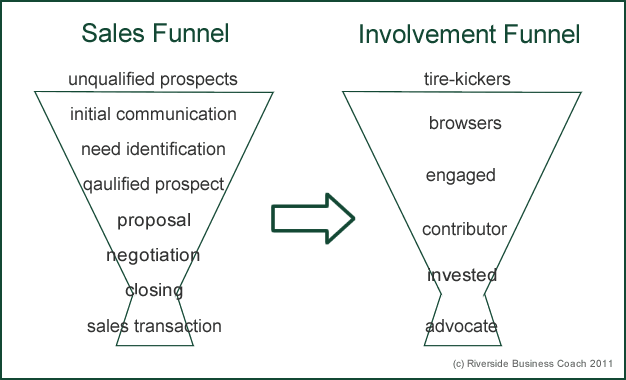 The sales funnel model of marketing is pretty familiar territory. It captures the idea that a marketing campaign attracts leads and the sales process converts these leads into prospects and ultimately customers. The People-You-Know approach is quite different. In this world there is an ongoing engagement with customers about the ideas and values shared between the business and customers. Parallel to the traditional sales funnel model your overall marketing campaign creates awareness of your business. This can be as simple as a sign on your business. But, once people move beyond the “tire kicker” phase and become “browsers”, the engagement becomes more intense and varied. Browsers display a repeated but low level engagement with the product or service sphere of your business. For instance if your business is a store front dog care provider, “Pooch Haven”, a browser might be the person who stops by on the occasional Saturday.
As your engagement deepens interactions become more detailed, more frequent, and, well, more engaged. This requires you to share more information and exchange real thinking about the topics at hand. In internet business models, this involves interactions via user groups, wikis, and other social tools like Twitter and Facebook. In this way the traditional marketing campaign becomes a Web marketing campaign. This plays a very important role in re-engaging old customers.
NEXT STEPS – CARRYING OUT THE MARKETING CAMPAIGN
Now comes the tough part. You have to actually do the work of renewing contacts with old customers consistently while you are doing all of the other tasks required to keep your business moving ahead. This is where your spreadsheet with all of those names in it comes in handy. Pick out a number of old customers, friends, and vendors you can really handle each week and get to work. Some can be contacted by email. This means crafting a brief email with a focused sample story that will be of interest and nothing more. No calls to action. This is a message in which you are adding some information that may be of interest or real value to them. If it does nothing else it will just remind them that you are alive.
Other old customers may benefit from a telephone call. These are likely to be the people with whom you had a closer relationship in the past. Just remember to be polite about the timing of the call. Always ask early on whether this is a good time to chat for a few minutes. If not, ask when you can call back. For customers and friends with whom you were really close, a breakfast (this is the easiest since it is before the work day begins) or lunch. As you work through your list and renew contacts keep a few practices in mind.
First, no selling or pitching for business. Never, never, ever.
Second, share information and stories that will be of interest and add value to your counterpart. New developments, new applications, new trends, anything that you have observed about the shared spaces between you is great stuff. They will reciprocate.
Third, ask for referrals. Ask your friend whether there is someone else they know who might be of interest for you to meet. Someone who can add and extend your knowledge of the field, markets, trends, etc. It is not uncommon for people to spontaneously offer to connect you with a new person. But, if they don’t, ask.
Fourth, ask them what is going on at their company or in their work life. They will share this easily. Who doesn’t like to talk about their world?
Fifth, if something comes up in the course of your conversation that requires follow up, write it down as a note in front of them. This sends the signals that you are taking the information seriously. Of course this also means that you MUST follow up as required.
Over and over in my work with all types of companies, I am reminded of how valuable the people you already know are to your sales. Repeatedly clients have increased their sales by focusing a significant portion of their marketing efforts on rekindling old customer relationships and maintaining the active ones they have. Following the steps discussed here can move you forward in capturing this army of customers hidden in your past.

 Peter Drucker’s The Effective Executive was first published in 1967 and has been in print ever since. I first read it during the 1980s. When I began to coach general managers and owners of small businesses I re-read it with a fresh perspective.