
Customer Engagement in Product/Service Development – new hints from Nokia

It is widely accepted that the more closely tied, integrated even, customers are in your development process for new products and services, the more likely success will follow. An April 13, 2008 article in the New York Times Magazine, “Can the Cellphone Help End Global Poverty – why a corporate ‘user anthropologist’ is spending so much of his time in the shantytowns of the world” (by Sara Corbett) sets a new standard. Nokia has Jan Chipchase wandering about the world seeking out what the next three billion cell phone users desire.

The first billion cellphones sold in 20 years; the second billion in four years; and the third billion in two. 80% of the worlds population live within range of a cellular network. The uses cell phones are already being put to in the underdeveloped world are quite unlike those in the developed countries. The only way to understand these and to begin to elicit input from new users is to go out and ask them, face-to-face. So, Nokia has full time personnel, on the ground, sending reports back to headquarters and trying out mockups of potential new products with real people.

It would serve everyone who is envisioning a new product or service to ask themselves:

  • “Have I actually asked real customers what they want or need?”
  • “Have I tested my ideas and received direct feedback that my product actually delivers a value someone wants to pay for?”
  • and so on.

Don’t let your engineers, marketers, sales people, or worse, you own enthusiasms, substitute for live human feedback.
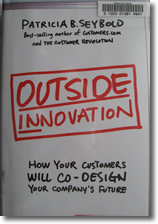
Book Review: Outside Innovation by Patricia Seybold

May 5th, 2008

The transformation of “customer driven”, “customer-centered”, “customer-defined” from just empty buzzwords in the latest management books to central values, key strategic skills is continuing.

Patricia Seybold’s 2006 book Outside Innovation: How Your Customers Will Co-Design Your Company’s Future (Harper Collins, New York 2006) provides a broad review of many techniques used by a wide range of companies to incorporate customers and customer ideas into product design. The book is sufficiently current to include examples for web-centered customer environments. Ms. Seybold has gathered a large number of examples in varying market segments. This makes the book a worthwhile read just for these through examples. Unfortunately, the formalization of the ideas remains low. This makes this book look and feel like a collection of anecdotes. The book closes with “Five Steps to Outside Innovation”, “Five Core Competencies to Master”, and “Five Pitfalls to Avoid”. Unfortunately Ms. Seybold never really develops her copywrited, “Customer Scenario” to organize the methods and approaches to get beyond the notion that customer inputs to innovation are a series of “I want….” statements.

Getting the Right Things Done – the manager’s focus

Peter Drucker wrote a charming little book in 1967, The Effective Executive: The Definitive Guide to Getting Things Done. I have now read it numerous times and each revisit rewards me.

Just this morning I was speaking with a manager about efforts to refocus a business on new services and the difficulty of dragging along the old, tried-and-true services that still have a customer base and generate revenues. Drucker had quite a bit to say about this problem of the past. In the chapter titled, First Things First, he wrote, “Systematic sloughing off of the old is the one and only way to force the new.” And, “Yesterday’s successes ….. always linger on long beyond the productive life.”

Drucker wrote in the same chapter, “It is more productive to convert an opportunity into results than to solve the problem — which only restores the equilibrium of yesterday.” This seems like quite a provocation to most managers. After all, managers and management are all about problem solving. Or so we seem all to think. But, from Drucker’s perspective, problems are always about the past. This is very clear from his notion that solving problems only reestablishes the status of the past, some sort of guarantee that we can reproduce the results of the past. Whereas, opportunities are about the future.  The future is where customers in the real world are, not in the past. Drucker sees the world as continually evolving and requiring new solutions to new problems, always defined by customers.

So, then, back to where I started. One of the hardest things for any manager to do is to look away from the products and services of the past. These may very well still be producing revenues and profits, though analysis and planning are telling them that future customers and revenues must come from elsewhere.

Customer-Centered Business – Peter Drucker and Web Marketing

Drucker

Recently I have been returning to Peter Drucker‘s work, specifically The Practice of Management (originally published in 1954, the current edition is HarperBusiness, 1993). On page 50, Drucker says the following:

“What is our business is not determined by the producer but by the consumer. It is not defined by the company’s name, statutes, or articles of incorporation but by the want the consumer satisfies when he buys a product or service. The question can therefore be answered only by looking at the business from the outside, from the point of view of the customer and the market what the consumer sees, thinks, believes and wants at any given time must be accepted by management is an objective fact deserving to be taken as seriously as the reports of a salesman, the tests of the engineer or the figures of the accountant — something few managements find it easy to do. In management must make a conscious effort to get honest answers from the consumer himself rather than attempt to read his mind.”

Customer -Centered Business

So here we are reading something written in 1954 that is still very difficult to do. Almost everyone in business speaks the words, the rhetoric,  of the customer centric business. But it still seems incredibly difficult to overcome the centripetal forces of day-to-day business and really engage customers directly and frankly.

Web-Marketing

A recent social web marketing seminar (Social Media Club Boston) reminded me again of this very same problem. One of the presenter’s, Greg Jarboe, SEO-PR, told a wonderful story of  how Southwest Airlines learned that though they might forbid the use of the word “cheap” internally, customers on the web are searching for “cheap airfares” not “inexpensive” or “frugal” or “cost-effective”. Even on the web, or perhaps even more so, the customer defines the terms and values of the game. All the more reason to put effort into finding out what they customer really wants.

Job Shops, TPS, and Intuition

Recent work with a client brought home to me again the interplay of TPS (Toyota Production system) and intuition.

We were working on developing a job scheduling system in a classic job shop environment. We had worked out a rough value stream map from sales inquiry to shipping. It was clear that there was very little data anywhere. This was a small business environment where everything existed in the heads of the key players. The owner repeatedly asked when we were going to get to the job scheduling system and, “Mark, what is it going to look like and how will it work?”

I kept fending the team off by telling them that we had to push our mapping as far as we could and then, “The answers will appear from the map. It will be clear to all of you how to solve the problems.”dscn0971.JPG

So, we pushed ahead until we reached the point where we needed to develop a simpler sense of the flow of the work. When I asked the team to identify the key groups of activities among all of the ones on the wall, they readily came up with five and, with a bit more discussion, we ended up with seven work centers. Based on the group’s intuition we then designed some job packages and a rough scheduling board to help us put into practice a visual job scheduling system.

This system is now up and running. Improvements are coming regularly. For the first time in the history of this 22 yr. old business, everyone can see what jobs are on the floor, where they are, and each person can pickup a job packet and know what it is that needs to be done in their work center without asking for advice, very often.

The key for me is my faith, demonstrated repeatedly in action, that value stream mapping and job shop lean flow processes can encompass just about any job shop environment. If you follow these practices you will reliably discover a solution that will produce significant steps towards a high-performance business. And, the best part is that with your guidance (and keeping your mouth shut) the team will discover their own solutions that they can continue to improve long after you depart.

Must Read Web Marketing Book: D. M. Scott’s “The New Rules of Marketing & PR”

Michael Volpe, VP Marketing at Hubspot, the web marketing software company, pointed me to this book in one of his presentations. I have been sufficiently impressed by the quality of HubSpot’s work that I ran over to my local library and signed it out.

newrules_dmscott.jpg

The New Rules of Marketing & PR is a breakthrough book for me about the new world of web-marketing. Here is Scott’s list of the new rules of marketing and PR (I added the numbers to the list for reference later):

  1. Marketing is more than just advertising.
  2. PR is for more than just a mainstream media audience.
  3. You are what you publish.
  4. People want authenticity, not spin.
  5. People want participation, not propaganda.
  6. Instead of causing one-way interruption, marketing is about delivering content at just the precise moment your audience needs it.
  7. Marketers must shift their thinking from mainstream marketing to the masses to a strategy of reaching vast numbers of under-served audiences via the Web.
  8. PR is not about your boss seeing your company on TV. It’s about your buyerts seeing your company on the Web.
  9. Marketing is not about your agency winning awards. Its about your organization winning business.
  10. The Internet has made public relations public again, after years of almost exclsuive focus on media.
  11. Companies must drive people into the purchasing process with great online content.
  12. Blogs, podcasts, e-books, news releases, and other forms of online content let organizations communicate directly with buyers in a form they appreciate
  13. On the Web, the lines between marketing and PR have blurred.

Numbers 3, 4, 5, 6, 11, & 12 are the core of the message. And I might add a couple of more notes here. First, all of this is hard work. You don’t hire some outside ad firm to handle this. People intimate with your company’s core values need to be involved. But, then, this means that with a bit of good focus and time management, you also do not need to spend a lot of money to utilize these tools. Second, the role of truth seems central to how you communicate, listen to, converse with, and engage your audience, your clients and customers.

Scott’s book is very well written and clearly organized. This is a must read for those of us still trying to figure out how to leverage the new web-marketing world. It provides a great introduction to seeing an overall strategy for web-marketing.