To-Do List – what makes some successful task managers

to-do-listEveryone has a to-do list. Even if you keep it in your head, everyone has one. I use a simple app on my iPhone that syncs with the same app on my iPad and on my desktop to manage my to-do list. This is a recent replacement for a technology I used for 30 years, 3×5 note cards (preferably un-ruled) that stuck out of my shirt pocket.

Regardless of the to-do list technology employed, I am sure that your to-do list is almost always longer than can be fulfilled and increasingly filled with “overdue” tasks. Mine is chronically creeping in that direction.

A recent article on Brain Pickings (BrainPickins.org) “A Brief History of the To-Do List and the Psychology of Its Success” by Maria Popova reviewed some recent research  ((mostly focused on a chapter about to-do lists, the third chapter, titled “A Brief History of the To-Do List, From God to Drew Carey,” in Willpower: Rediscovering the Greatest Human Strength by John Tierney and Roy F. Baumeister)) ) that touches on two useful points. Continue reading

Who Says Content Is Not Still King on the Web?

“Content is King!”

This phrase, now seemingly completely worn out in the ever newer world of Web 2.0 going on Web X.0, is really still true. Now, in the world of increasingly flashy Web production values, it is time to resurrect this slogan and put it into action in your business. This is especially important for small business people who cannot afford the “finer things” on the Web. Time to take a look again at your value to your customer niche and bring back content, real, genuine, authentic in all its quirkiness, your content.

Jessica Beinecke - OMG!Here is an example of a young woman, Jessica Beinecke,  teaching idiomatic English to learners of English in China. She is now reaching millions of people. And, she is doing this with no other production equipment than a laptop computer and some lights.

Why is she so successful? Watch.

‘OMG!’ Exports American Slang to China – from The News Hour – Friday 02/10/2012

and here is her lesson for Valentine’s Day.

Bad Things Do Happen – Are You Prepared?

Do You Have Insurance?

How many times have I asked clients, “Do you have insurance on your business assets? Do you have liability insurance? Key person insurance?” For many small business people these questions are a combination of absurd and uncomfortable. Frequently I am brushed off with, “I can’t afford that.”

Can You Afford This? Continue reading

Management Skills for the Effective Manager – Drucker’s The Effective Executive – 2

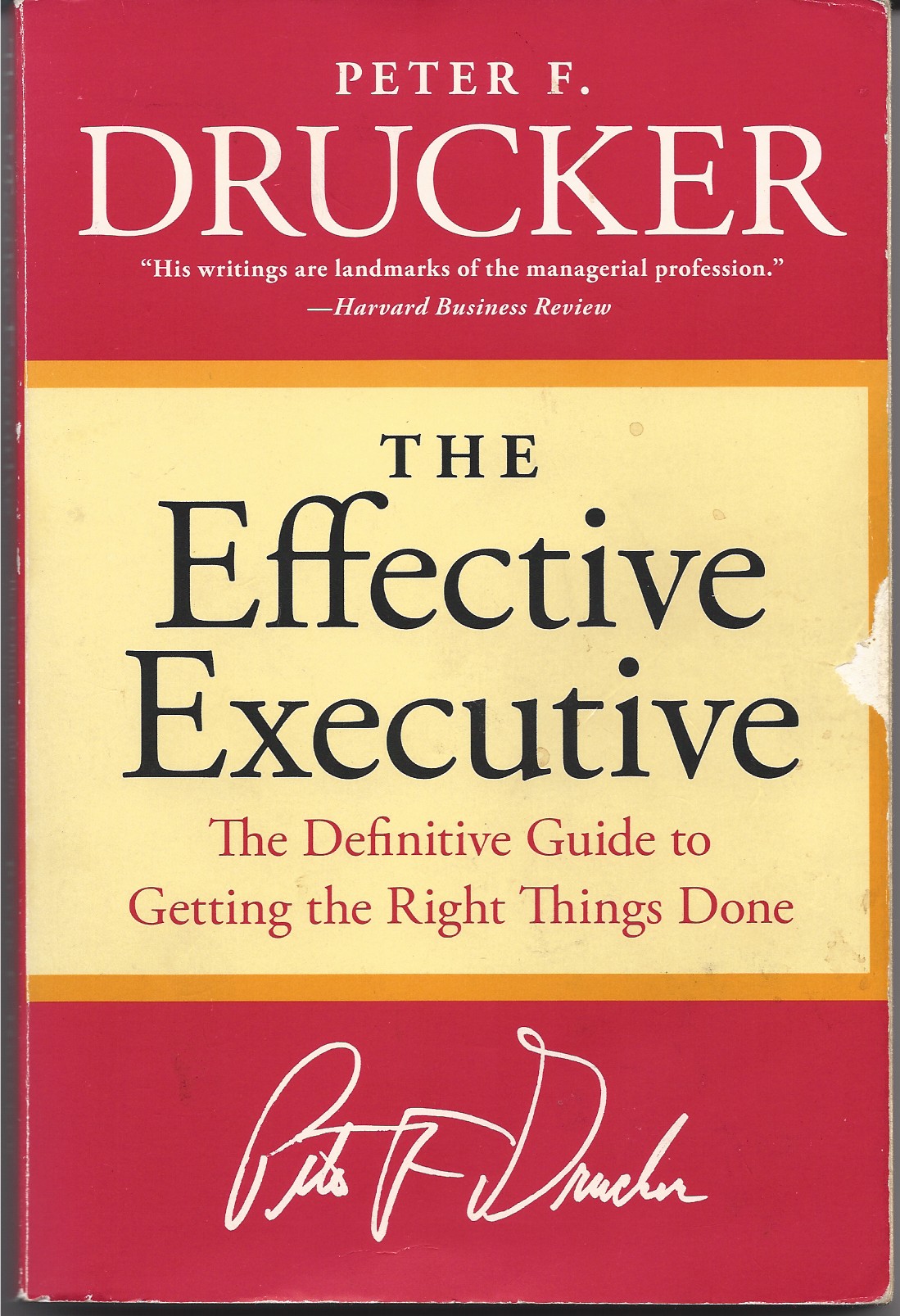
Peter Drucker's The Effective ExecutiveIn Peter Drucker’s The Effective Executive, he outlines eight management practices in the introduction that are the core skills of the effective manager:

  • They asked, “What needs to be done?”
  • They asked, “What is right for the enterprise?”
  • They developed action plans.
  • They took responsibility for decisions
  • They took responsibility for communicating
  • They focused on opportunities rather than problems.
  • They ran productive meetings.
  • They thought and said “we” rather than “I”.

But, before really getting to work on these he takes on some very interesting foundational issues. First, “… the executive is, first of all, expected to get the right things done. And this is simply that he is expected to be effective.” ((All quotations in this posting are from pp. 1-24. Here is an early example of how the style, and many of the examples, in The Effective Executive are quite dated. The pronoun “she” never appears in the book. When he wrote the book in 1967, women in management were extraordinarily rare and their was only a nascent awareness that women could and should play a full role in our economic and social institutions ))  

What is effectiveness? Continue reading

Management Skills for the Effective Manager – Drucker’s The Effective Executive – 1

Peter Drucker's The Effective Executive

Learning how to be an effective manager is a primary task for every manager. However, most managers learn management skills on the job  without guidance and in a haphazard fashion. A few companies have formal mentoring programs but, of these, few have a structured approach. Very few courses are offered in business schools on how to be an effective manager. To the extent that a manager becomes an effective manager, it is learned by stumbling about and reinventing the wheel.

Peter Drucker’s The Effective Executive: the definitive guide to getting the right things done  (( I am using the 2006 edition published by Harper Collins. I will also refer to The Effective Executive in Action by Drucker and J. A. Maciariello published by Harper Collins, 2006)) has been a continuing resource for me in learning how to be an effective manager and teaching others these management skills . I find myself re-reading it in parts and all of it every year. To spread the wisdom around and reflect further on this guide for the general manager ((I use the word “manager” throughout in place of “executive” because I believe that Drucker’s ideas scale up and down the management hierarchy very well. These are lessons for everyone one from front line supervisor to CEO)) I will devote a series of postings here to its content on how to be an effective manager. Continue reading

Meetings – where you begin to be a more effective manager

A recent New York Times article “Building a Better Teacher” by Elizabeth Green ((March 2, 2010 http://www.nytimes.com/2010/03/07/magazine/07Teachers-t.html)) told the story of Doug Lemov’s discovery that a large component of high performing teachers’ success came from their classroom management skills. While reading the article, and, especially watching the videos of teachers actually employing good class management, I was struck by an interesting parallel in the management world. Just as education schools do not do a good job of preparing teachers to know what to do when they first walk into a classroom, most managers learn their craft by trial and error. They have little help from mentoring or development programs in their companies. And, business schools seem to provide little guidance either.

Meeting management is to effective managers as classroom management is to successful teachers

Meetings are a great place to start to learn the management craft and a crucial platform for driving and sustaining high performance. Great managers and great organizations have great meetings. And, from the perspective of a manager interested in developing a high performance culture, meetings are a great starting point in building a high performance company. After all, meetings exhibit all of the important attributes of high performance organization and culture. And, no effective manager can be ineffective in meetings.

Good meetings:

  • focus on results ($s, people and values)
  • engage, empower and demand every participant’s energies
  • use fact-based thinking
  • orient to customer needs (internal and external)
  • devolve strategy into tactics
  • employ process and systems thinking
  • use well-developed problem solving tools and approaches
  • focus on adding value for customers (internal and external)
  • look for waste reduction
  • build on company and individual strengths
  • among the more important……

Meetings are a great place to start because they are a regular event in which the manager has significant control and can demonstrate, concretely, high performance principles and practices in front of, and with their direct reports.