A revisit to David Allen’s book, Getting Things Done. Get stuff out of your head, follow the two minute rule, file things away, work strategically and tactically.
A Revisit to David Allen’s Book, Getting Things Done:

A Revisit to David Allen’s Book, Getting Things Done:
Learning to be an effective manager is almost entirely a self-guided learning enterprise. Almost no business schools even approach the topic despite the hundreds of courses they offer on almost every functional aspect of management ((see Henry Mintzberg, Managers Not MBAs: A Hard Look at the Soft Practice of Managing and Management Development, 1st ed. (Berrett-Koehler Publishers, 2004) for more on this.))
So it was with some anticipation that I read through Robert E. Kelley’s How to Be a Star at Work: 9 Breakthrough Strategies You Need to Succeed (Three Rivers Press, 1999). This book is based on research at Bell Labs in the 1980s, and 3M a bit later, on the differences between “stars” and average managers. . Learning to be an effective manager is a multi-disciplinary-multi-modal effort. Clearly an important step is to understand what constitutes the approaches, practices, and skills of an effective manager. 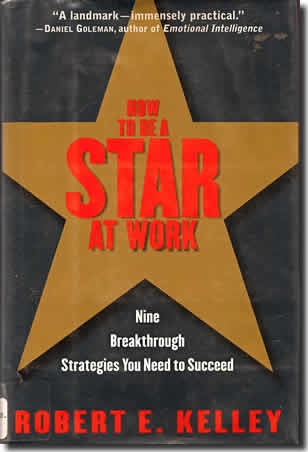 Based on work with hundreds of managers, Kelley found that there was no significant difference between “star” and average managers in their raw intelligence, problem solving skills, and technical skill attributes.This may seem surprising until you remember that accomplishing real results in the business world is not a based on individual performance but on the collective efforts of a whole organization. There are almost no significant business problems (or technical ones, too) that can be solved by a single individual. In fact, it is the job of a manager to bring together all of the resources required to achieve real results, focus them on the task and push, pull, inveigle, cajole, lead, or any other verb that describes the persuading that goes on to organize groups in action to achieve real results. Viewed from this perspective it seems less surprising that being a “star” manager has more to do with attributes other than raw intelligence, problem-solving, and technical knowledge.
What Kelley did find was that the stars has better strategies and skills in nine areas:
There is some overlap among these nine strategies. For instance Followership, Teamwork, and Small “l” leadership are clearly interdependent ideas. But I do not want to quible here. If you compare this list with the attributes of high performance organizations you will find useful correlations and synergies.
This book is widely available through your local library and from bookstores local and online.
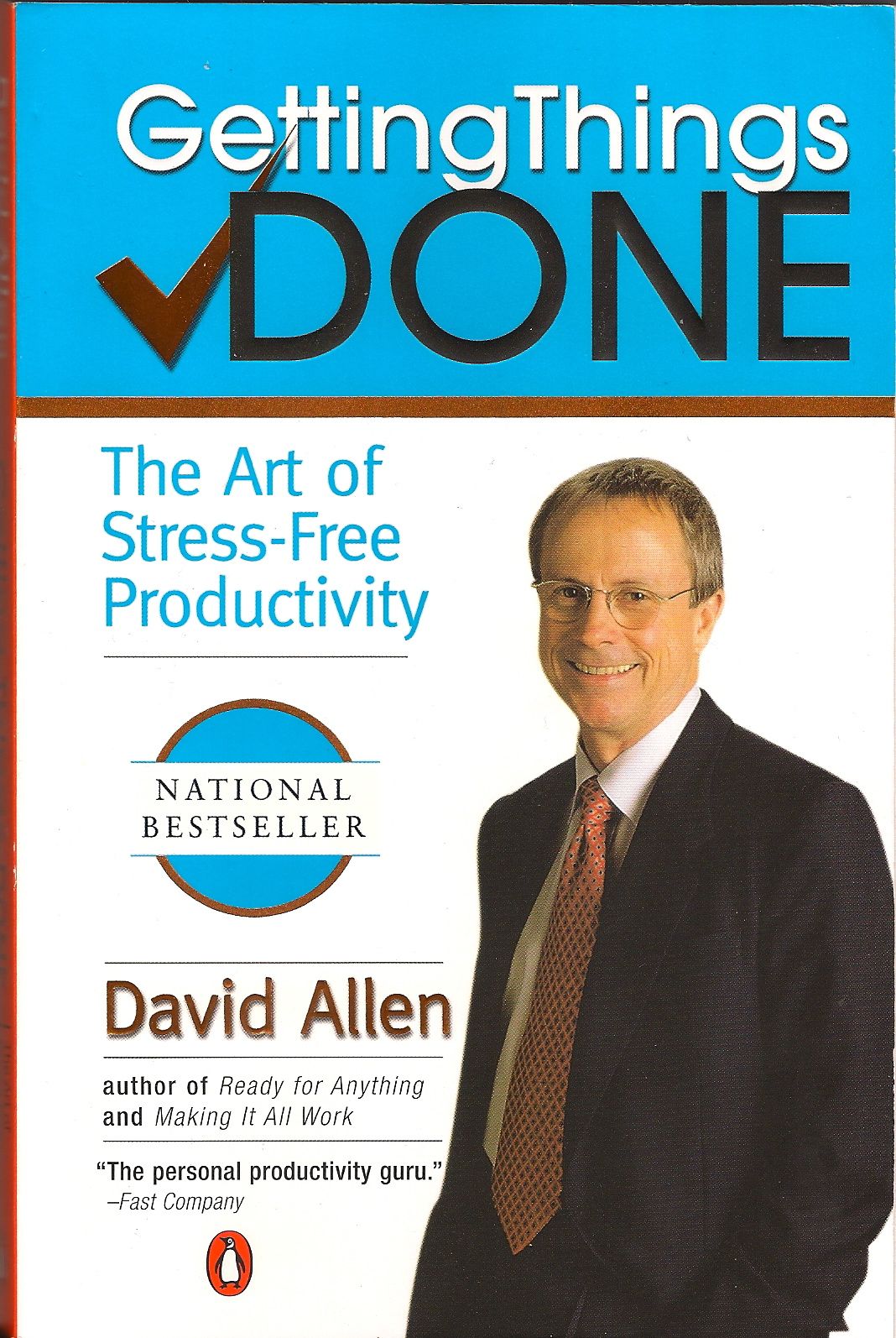
I have used David Allen’s book, Getting Things Done: the art of stress-free productivity (Penguin: NY 2001) both personally and with clients for a number of years. Recently I volunteered to lead a discussion of the book’s approach to personal productivity with the Greater Boston Business Network. This provoked me to re-read the book in preparation. Here are a few thoughts following my re-read and the discussion with GBBN.
Work and personal are now quite blurred. And so, this book is about everything in your life. There is no boundary between work and personal when it comes to being more productive. And, your mind does not treat them as separate, so a productivity system can not either. There is also a need to incorporate the big picture, strategic view, with the tactical day-to-day, but the emphasis must be on actionable tasks. Thus, the title, Getting Things Done.
Getting into a “Productive State”, what I might call a state of flow, when required is both a challenge and an objective of a productivity system. ((Here you might compare this with the work on how we work best in a state of “flow” as discussed in see Mihalyi Csikszentmihalyi’s Flow: The Psychology of Optimal Experience ( Harper Row, NY: 1990)))
Allen builds his approach to productivity on a few “principles”.
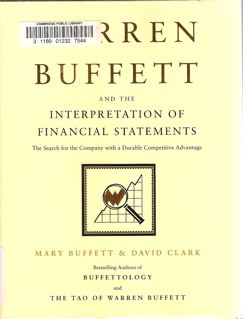
I picked up this little book, Warren Buffett and the Interpretation of Financial Statements – the search for the company with durable competitive advantage (Scribner: New York, 2008), thinking that I might learn something valuable about the current economic mess and as a possible guide to shaping personal investment decisions. However, from the small investor perspective of building long-term wealth the strategy is summed up in the tag line: “durable competitive advantage”. ((My attention for that purpose has shifted to another more compelling analysis – John Bogle’s The Little Book of Common Sense Investing (John Wiley & Sons, Hoboken NJ, 2007) ))
But, to return to the Buffett book, I am struck by another use of this book. That is as guide to the basics of how to read and interpret the important elements of a company’s financial statements. The book covers The Income Statement, The Balance Sheet, and The Cash Flow Statement. If you feel uncomfortable or completely ignorant of these three financial documents, this book might just do the trick.
While you are learning about Warren Buffett’s approach to durable competitive advantage, you will be lead through a tour of these three statements. This is a very literal line by line march. For instance, thirteen chapters, averaging three pages each, cover all of the common elements of the income statement. With the example statement always in sight it is easy to follow the calculations to see what Gross Margin or Earning per Share mean. If you find Depreciation a mystery, this is covered too. In this era of excessive leverage, the book carries along a discussion of the impact of debt on the performance of a company.
So, pick up this book at your local library or buy it. You will understand more about the how and why of Warren Buffett’s strategies and learn to understand financial statements. Then, get out your own statements and march through with this book as a guide.
Multitasking is worse than a myth; it is a fraud and a thief. Other lessons learned
[display_podcast]
This podcast is 7 minutes 24 seconds long.
You can read the text here.
Last week I ran into a little book (it really is little, 135 pages in a 5″ x 7″ format – very easy on the hand and eye), The Myth of Multitasking: How “Doing It All” Gets Nothing Done by David Crenshaw (Jossey-Bass: San Francisco 2008).
The initial chapters take up the question of humans as multitaskers. For those who need to be reassured that the common sense answer to this question is, in this case, more than common, that it really is the sensical answer, take the time to follow the narrative. Yes, this is one of those business books written as a story. In most regards I have come to think of the first such approach that I know of to writing a business book in a narrative story format, The Goal: a process of ongoing improvement, by Goldratt, wishing it had been the last. But, I digress.
Crenshaw introduces the notion that because we really are capable of only one task at a time, the appearance of multitasking is really a series of “switchtasking” in which we shift our attention back and forth among a number of tasks. This process incurs significant inefficiencies due to the housekeeping overhead of our brain keeping track of where we are starting and stopping with each task. Significant errors also occur as a result.
The proliferation of information devices over the last decade has multiplied the opportunities for interruption and created environments which are perpetually competing for our attention. Email, cellphones, voicemail, instant messaging, text messaging, faxes, and more clutter our desks, pockets, belts, pocketbooks, backpacks, hands, and, ultimately, our brains. As Crenshaw aptly states, “The reality, though, is that these things will make us productive only if we learn to take control of them….If you and I don’t set up a schedule and protect our time, we allow ourselves to be run over by the traffic of information.” (page 61).
Crenshaw goes on to suggest a strategy for doing just that, establishing a schedule. I have written earlier about the need to avoid Too Much Information.
In Crenshaw’s approach to meetings which calls for establishing “recurring meetings” where people regularly need to meet with you, I think that an opportunity for a deeper understanding of what is happening is missed. The first step with meetings is to examine the reasons for the meetings. Altogether too often meetings are symptoms of poor underlying business processes, especially decision making. Many meetings turn out to be about how a decision is to be made, what information applies, what are the boundary conditions and parameters, and so on. These meetings should be replaced by sound business processes that make the decision making faster, closer to the end user, and more reliable. Other meetings will turn out to be program or process status meetings. These too should be replaced with better business processes and visual status reports. In general a manager should view every meeting where they do not add significant, singular value as a symptom of opportunities to improve processes.
Crenshaw’s approach to developing a time budget seems to me just a re-run of the age old time management gurus’ spreadsheets in which we keep track of all activities for a number of weeks and then analyze them for waste. In my experiences personally, and with clients, this approach does not work well. A significant number of people simply will not maintain a log of their activities in sufficient detail and at enough length to really be useful. More troubling, very few are able to act on the results of the analysis.
I have come to relie on a Seize Your Time approach which I have written and spoken about frequently. Basically, this works as follows:
Take out your schedule for the next week. Block out two hours during which you will post on your door a sign saying, “Do Not Disturb”, turn off all communication devices including your beloved Blackberry (iPhones, too) and work without interruption on some valuable project that will move your organization forward.
You can read more about this in my Time Management postings and podcasts.
One area in which Crenshaw strikes on a rich vein of truth is his discussion of “business systems” and “personal systems”. Here he points out the fact that the “personal system” of the business leader becomes de facto the “business system” of the company.
Many business managers and owners act as though magically their behavior is disconnected from the behavior of their company. They engage in the delusional notion that people throughout their company do not notice how they behave, how they make decisions, what their priorities are, what their values in dealing with people and other companies are, in fact, almost everything they do or say (mostly do).
Fortunately, this is not true. Why “fortunately” you might ask. The answer is that the behavior of the leader of small and medium size businesses has dramatic and reliable impacts on the performance of the company. And, since we do know what constitutes high-performance in business leaders, the leader can learn the appropriate behaviors, actively model them in their own performance, and see the results cascade through their firm.
I applaud Crenshaw for taking on a popular buzzword and small-scale plague not only in business life, but also our day-to-day world. Multitasking is indeed a myth. I would be tempted to be more vigorous in my rhetoric and say that multitasking is a fraud and a thief.