
Must Read Web Marketing Book: D. M. Scott’s “The New Rules of Marketing & PR”

Michael Volpe, VP Marketing at Hubspot, the web marketing software company, pointed me to this book in one of his presentations. I have been sufficiently impressed by the quality of HubSpot’s work that I ran over to my local library and signed it out.

newrules_dmscott.jpg

The New Rules of Marketing & PR is a breakthrough book for me about the new world of web-marketing. Here is Scott’s list of the new rules of marketing and PR (I added the numbers to the list for reference later):

  1. Marketing is more than just advertising.
  2. PR is for more than just a mainstream media audience.
  3. You are what you publish.
  4. People want authenticity, not spin.
  5. People want participation, not propaganda.
  6. Instead of causing one-way interruption, marketing is about delivering content at just the precise moment your audience needs it.
  7. Marketers must shift their thinking from mainstream marketing to the masses to a strategy of reaching vast numbers of under-served audiences via the Web.
  8. PR is not about your boss seeing your company on TV. It’s about your buyerts seeing your company on the Web.
  9. Marketing is not about your agency winning awards. Its about your organization winning business.
  10. The Internet has made public relations public again, after years of almost exclsuive focus on media.
  11. Companies must drive people into the purchasing process with great online content.
  12. Blogs, podcasts, e-books, news releases, and other forms of online content let organizations communicate directly with buyers in a form they appreciate
  13. On the Web, the lines between marketing and PR have blurred.

Numbers 3, 4, 5, 6, 11, & 12 are the core of the message. And I might add a couple of more notes here. First, all of this is hard work. You don’t hire some outside ad firm to handle this. People intimate with your company’s core values need to be involved. But, then, this means that with a bit of good focus and time management, you also do not need to spend a lot of money to utilize these tools. Second, the role of truth seems central to how you communicate, listen to, converse with, and engage your audience, your clients and customers.

Scott’s book is very well written and clearly organized. This is a must read for those of us still trying to figure out how to leverage the new web-marketing world. It provides a great introduction to seeing an overall strategy for web-marketing.
Book Review – Join The Conversation: how to engage marketing-weary consumers with the power of community, dialogue and partnership by Joseph Jaffe

In my continuing search to understand more about web-marketing, I have now read through Join the Conversation: How to Engage Marketing-Weary Consumers with the Power of Community, Dialogue and Partnership by Joseph Jaffe (Hoboken, NJ: Joseph Wiley & Sons, 2007). This book is written in a somewhat tiring style of froth, frenzy, and chattiness. Nevertheless, it adds further fuel to the notion that the traditional marketing categories of the four Ps (in case you have forgotten: Product, Place, Price, and Promotion) are now quite outmoded. In place of the old tradition, Jaffe introduces the “Six Cs”: Content, Context, Customization, Community, Conversation, Commerce. Unfortunately, Jaffe does not develop the ideas behind Contecxt and Customization with any real vigor and in the end it is not clear even what these Cs mean.

Content is King

Content that is real, meaningful, and fresh in the eyes of the visitors to your website is king. There is a consensus that content is king. And, for most companies generating content is really hard work.

Jaffe spends most of his energies around Conversation, what is it, how to get it started, how to participate (listen), and how to build relationships on it. There are some good lists of characteristics of conversations and Dos and Don’ts.

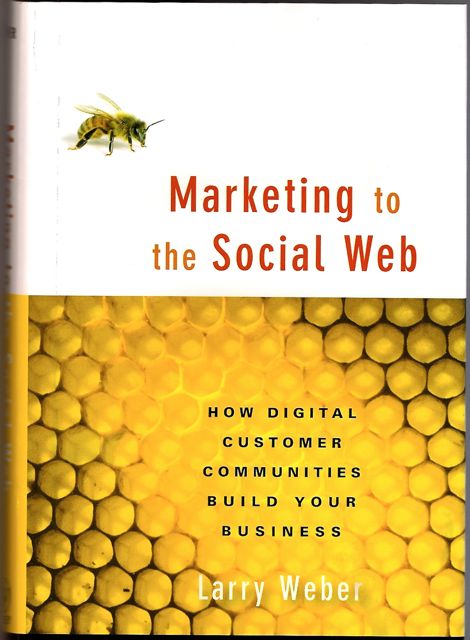
Book Review – Marketing to the Social Web by Larry Weber

Marketing and selling over the Web has been a required activity for almost every business I have been involved in for over ten years. In the last couple of years, the web has continued to evolve and now in some undeniably novel ways. The most notable are the appearance and enormous growth of “communities” or “social networks”. It is clear that the existing web marketing paradigm that focuses on pay-for-click advertising and search engine optimization (SEO) is being enormously enriched by the opportunities presented by social or community oriented environments. This later change requires real shifts in the approach and objectives for marketing on the web.

Just as I have begun to attempt my own synthesis of these changes, I have come upon Marketing to the Social Web: how digital communities build your business by Larry Weber (John Wiley & Sons, New York 2007). The author has extensive experience in the Web world and provides more than enough examples and anecdotes to illustrate his case.

The basic argument of the book is that the interactivity of the web is now producing completely new ways in which companies and customers can interact.

Weber develops seven steps to marketing on the social web:

  1. Observe – see where, what and how your customers do in the social web. Check out blogs, conversations, relevant content, etc.
  2. Recruit – enlist core participants who want to talk about your company, its products and services.
  3. Evaluate platforms – which platforms are best to reach your marketing objectives – blogs, reputation aggregators, social networks?
  4. Engage – this is all about developing and maintaining content – user generated and yours.
  5. Measure – develop metrics relevant to the objectives and measure.
  6. Promote – connect with other communities in the web.
  7. Improve.

Weber provides lots of discussion and anecdotes to illustrate each of these seven steps. Then he adds four strategies to expanding the reach of marketing on the social network – (1) SEO, (2) blogs, (3) e-communities, and (4) social networks.

This book is a solid contribution to understanding and participating in the ongoing development of the web world. This is esepcially so for creating a more productive balance between traditional web marketing, pay-for -click advertising and SEO, and the emerging world of the social web.

Book Review: Customer Advisory Boards by Tony Carter

As a bit of preface to these remarks, I approach customer advisory boards (CABs) from earlier experiences with supplier advisory boards and customer participation in product development. This may variously prejudice or inform here.012506_book-714720.jpg

Customer Advisory Boards are powerful tools for engaging with customers in a variety of dimensions. Companies are using them to interactively work with their customers on developing new products and services, to keep them abreast of changes in their customers’ perceptions of the changing landscape of their business world, and more. CABs provide a platform to share and develop in an environment where the customer is present and participating. CABs are used by big and small firms, They are relatively inexpensive and potentially very high in rewards. Given this, it is of immediate interest to read a book on this topic.Customer Advisory Boards: a strategic tool for customer relationship building by Tony Carter (Binghampton, NY: Best Business Books Haworth Press, Inc. 2003)The tagline for this book, “a strategic tool for customer relationship building” only hints at the confusion of ideas within its covers. 45% of the book, “Section I:Customer Relationship Building”, is taken up with a discursive sampling of theory and practice in relationship selling, customer-centered value, and the ‘nature of relationships” (this includes a side venture into leadership and emotional intelligence theories). Many of these discussions are interesting, even provocative in themselves. Unfortunately, Carter makes no organized effort to map these onto the actual topic at hand, CABs. Further, Carter mixes in discussion of Advisory Boards for start-up firms with applications more typical for mature firms.The balance of the book, “Section II: Building Customer Advisory Boards” and “Section III: Strategic Uses and Effective Management” will not reward senior managers or consultants with much of practical value. The view of strategic value is limited to customer acquisition and customer retention. There is no useful discussion of how meetings are actually conducted, how participants interact, what values they might gain,or how the meeting facilitation role is accomplished. In the end much of these sections of the book are taken up with cases studies that seem only peripherally to shed light on CABs.For a book that pops up very high on a Google search for “customer advisory boards”, this is a disappointment.