Seven Reasons to Add a CFO – part-time or full – to Your Team

Many small businesses operate with only a bookkeeper and CPA to manage the finances. The owner or GM fills in, or at least think that they fill in,  for all of the duties of a Chief Financial Officer (CFO). As a result owners of these businesses frequently have inadequate financial information to effectively move ahead. And, they are frequently using scarce resources (their time) performing tasks far better done by a professional, experienced hand.

In this time of readily available outsourced or part-time professionals there are very few worthwhile reasons not to have your own CFO. Depending on your size, your CFO might appear once a month or several days a week.

So, let me list a few reasons for you to find a part-time CFO. Continue reading

Are You Afraid of Your Financial Statements?

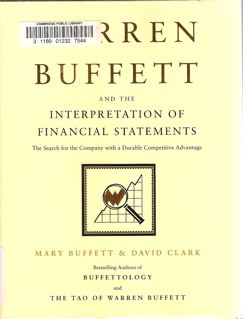
I picked up this little book, Warren Buffett and the Interpretation of Financial Statements – the search for the company with durable competitive advantage (Scribner: New York, 2008), thinking that I might learn something valuable about the current economic mess and as a possible guide to shaping personal investment decisions. However, from the small investor perspective of building long-term wealth the strategy is summed up in the tag line: “durable competitive advantage”. ((My attention for that purpose has shifted to another more compelling analysis – John Bogle’s The Little Book of Common Sense Investing (John Wiley & Sons, Hoboken NJ, 2007) ))

But, to return to the Buffett book, I am struck by another use of this book. That is as guide  to the basics of how to read and interpret the important elements of a company’s financial statements. The book covers The Income Statement, The Balance Sheet, and The Cash Flow Statement. If you feel uncomfortable or completely ignorant of these three financial documents, this book might just do the trick.

While you are learning about Warren Buffett’s approach to durable competitive advantage, you will be lead through a tour of these three statements. This is a very literal line by line march. For instance, thirteen chapters, averaging three pages each, cover all of the common elements of the income statement. With the example statement always in sight it is easy to follow the calculations to see what Gross Margin or Earning per Share mean. If you find Depreciation a mystery, this is covered too. In this era of excessive leverage, the book carries along a discussion of the impact of debt on the performance of a company.

So, pick up this book at your local library or buy it. You will understand more about the how and why of Warren Buffett’s strategies and learn to understand financial statements. Then, get out your own statements and march through with this book as a guide.


Product Line Analysis or Knowing Where the Profits Are

An important step for every business manager is to understand where profits are coming from. Too many managers are relying on  the basic Profit and Loss statement that comes to them from their accountant. This is not always a useful management tool.

Lets take a look at a situation where a web-based services company is experiencing good growth and reasonable profits. They have four lines of business addressing their single basic service to four different markets. Based on their market analysis, they decide that they will focus their marketing dollars and development resources on one of the four for the next year.

Six months into the mission, sales have continued upwards, but profits are not tracking along at the same rate, the quality of earnings is suffering. Why is this happening?

First they muscled their way through some spreadsheet work sorting out their COGS (Cost Of Goods Sold) and reassigning previously Fixed Expenses in marketing that really could be assigned to each of their four market areas. Then they discovered that the the market segment that they had focused their efforts on had never been very profitable and they had made the situation worse by increasing the sales volume through it.

On closer analysis it became evident that the lack of profitability came from two sources. First, the marketing costs of acquiring customers in  this market channel had been 60% higher than in  the others. Second, the vendor providing the back office services supporting this channel was 30% more expensive than vendors supporting the other market segments. In the short run, the managers decided to shift their focus to another one of their markets. In the long run they decided to search for a better vendor and conduct some research on why the marketing costs were so high.

So, if you have a business where you are selling more than one product or service to more than a lone customer, think about developing the financial management tools that will tell you where your sales and profits are actually coming from.