Financial Incentives – do they work?

Revisit an Important Topic – a repeat posting from 2013

It is accepted wisdom in human resource management practice that financial incentives, wages and bonuses, drive work performance ((Note that we are talking about individuals here. Organizations, for profit, non-profits and government, definitely react positively to financial incentives and disincentives)). This is a part of our business and political culture. ((In fact the notion that people make “rational” decisions based in part on financial rewards is a central pillar of our “if we only let markets work, everything will run smoothly” culture.)) Though studies and surveys have shown for decades that people find many other factors (growth of skills, engagement, sense of purpose, social connection, and many others) to be important in their work, the key to every human resource management strategy has been the compensation plan. Increasingly over the past couple of decades human resource management professionals have devised ever more complex methods for connecting various performance metrics to compensation plans. 

Do Financial Incentives Work? Continue reading

Getting Paid For Your Problem Solving – a lesson from behavioral economics

Dan_Ariely TED_in_2009

Dan Ariely at TED in 2009

I am currently enrolled in an online course at Coursera.org, Introduction to Behavioral Economics taught by Dan Ariely (well known for his  Predictably Irrational: The Hidden Forces That Shape Our DecisionsHarperCollins, pp. 304,ISBN 978-0-06-135323-9). 

In a discussion by Dan Ariely about the psychology of money he pointed out that people have a very difficult time paying for expertise. This doubtless even more so for problem solving expertise. Continue reading

Prospects and Networking – build success at the end of a conversation

The Critical Moment

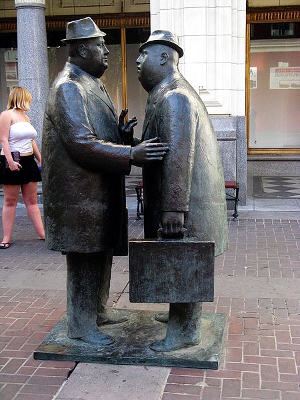
The Conversation by William McElcheran, Calgary Canada

Many people struggle with how to open a business conversation with a new person or prospects. Lets assume for the moment that you have solved that puzzle and are now actually engaged in a conversation, whether in person, on the phone or via email. Typically little thought is given to how to close a business conversation. Yet, this is a critical moment. Done with a little thought you set up the next conversation and deepen your business relationships with prospects and networking contacts. Before you say, “Thank you for taking so much time to speak with me.”(or whatever phrase you use to close a conversation), you must set up the next conversation with your prospects and networking contacts.

Continue reading

Product Obsolescence – an end of life process

The Human Body’s End of Life Process

Avram-Hershko-NYTs-06192012On June 19, 2012 the New York Times published an article, “The Body’s Protein Cleaning Machine” about the Nobel Prize winning chemist Dr. Avram Hershko. His life work has been on understanding how the body’s cells rid themselves of old, defective proteins. Every cell has a protein ubiquitin that tags old and degenerated proteins for destruction. “Maybe you’ve heard of Parkinson’s disease and Alzheimer’s? There we have bad proteins accumulating in the brain and destroying brain cells. The reason we don’t get Alzheimer’s when we are 10 is that when we are young, the bad proteins are disposed of quickly. With age, the cell’s machinery may lose the ability to do that.”

This very interesting notion that the body has a built-in mechanism to rid itself of bad proteins reminded me of old lessons about the need for our businesses to have a similar mechanism. Product obsolescence is a terrible drag on sales and gross margins. A better strategy is to have an end of life process to drive out product obsolescence. Peter Drucker ((Peter Drucker, The Effective Executive, Harper Colophon Books, p.108)) put it this way:

Systematic sloughing off of the old is the one and only way to force the new. There is no lack of ideas in any organization I know. “Creativity” is not our problem. But few organizations ever get going on their own good ideas. Everybody is much too busy on the tasks of yesterday. Putting all programs and activities regularly on trial for their lives and getting rid of those that cannot prove their productivity work wonders in stimulating creativity even in the most hidebound bureaucracy.

Are you persuaded that your business needs An End Of Life Policy? Continue reading

Perfection through Subtraction – The Little Prince

“Perfection is attained not when there is nothing more to add, rather when there is nothing more to subtract.”

Le Petit Prince book cover

Le Petit Prince book cover borrowed from GoodReads.com

Listening to an interview with an author about his writing process brought this wonderful quote from Saint-Exupery. ((He is the author of The Little Prince (Le Petit Prince if you got to third year French in high school), though the quote come from Terre des hommes))

Simple, clear, direct, user-friendly, straightforward, honest, classic, understated. These are some of the attributes that flow from thinking about your business with Saint-Euxupery’s aphorism in mind. In philosophy, science, and engineering Saint-Exupery’s aphorism is best expressed by Occam’s Razor where the razor shaves away the unnecessary assumptions.

Then, of course in the day-to-day world we have KISS – keep it simple stupid – that stands in for these more elegant formulations. The general lesson here is to beware of complex explanations, strategies, and plans.