Microsoft Goes Crazy – the Office Live Small Business tools

Yesterday’s New York Times contained an article by David Pogue, “Mom and Pop Get a Partner: Microsoft”, that announces a whole new suite of services for small businesses from Microsoft. And they are all virtually free. You can set up a website in minutes, purchase your own domain name for free for the first year, get email, use collaborative tools including calendaring, project management, shared documents and more. All of this come with some pretty powerful user access controls so that you can set up teams to collaborate internally or include your customers and everyone sees and changes only what they are supposed.

I would say that anyone in a startup or small business who does not already have a website and these other tools should immediately click on over to Microsoft’s OfficeLive site and check this out. This will require some real work to take advantage of all of the tools available here, but it is not often that such a comprehensive suite is available essentially for free.

If you add a few web-based applications for writing, number crunching, and presentations, clearly we are approaching the new world of cloud computing more rapidly than I had thought. I regularly use  Buzzword for my writing. Others may like the suites of tools at Google or Zoho, for example.

“Management Notes – the blog” Goes Mobile

Last night I attended a meeting of the Web Innovators Group here in Cambridge. Among the new businesses that caught my eye was Mofuse.com a mobile site creation company.

As I have been learning, the next phase of the Web is emerging on hand held devices. There may be 600-700 million PCs in the world, but there are already over 2 billion cell phones and the forecast is for 3 billion soon. Most of this growth will occur in the developing world. With the next generation of devices looking more like mobile computers, this means that most human beings will, in one generation, go from no telephone service to full-blown access to everything on the Web. I will restrain myself from further imaginings about the impac this will have on how and what we do.

Looking shorter term, I clicked over to the Mofuse website and hooked up my Management Notes blog to their mobile site creator. If you have a suitable mobile device you can now read this blog on the go at: http://businesscoach.mofuse.mobi/

I do not have a suitable mobile device so I am waiting for feedback from this distant universe.

If Content Is King on the Web? – What Are the Best Modes of Communication?

If you are trying to build traffic and adhesion for your business on the web, “content” is central to any strategy. But, what is this “content”? How do you decide what the content should be?

The answer to this question probably lies in some basic thinking about who your target customers are.

Jaffe Customer RolesIn addition it would be useful to think of the many ways in which you might communicate with your customers. On the web you have a lot of modes in which to play. As suggested by the excerpt ( shown to the left) from Joseph Jaffe’s Join the Conversation, a consumer can play a range of roles. So, in thinking about content, it may prove most productive to engage a parent of middle school children (in the Participant and Community faces a la Jaffe) in a conversation about barriers to better school performance in web community using blogging, bulletin board, or wiki techniques. Here your content expertise in middle school eduction can shine through in the discussion. And, you might even learn something about how parents view these issues.

A future departure for thinking about how to target and communicate with customers on the web is to lay Jaffe’s contribution of the Six Cs mentioned in an earlier blog article (opens new window) on top of his “Many Faces” idea show here.

Book Review – Join The Conversation: how to engage marketing-weary consumers with the power of community, dialogue and partnership by Joseph Jaffe

In my continuing search to understand more about web-marketing, I have now read through Join the Conversation: How to Engage Marketing-Weary Consumers with the Power of Community, Dialogue and Partnership by Joseph Jaffe (Hoboken, NJ: Joseph Wiley & Sons, 2007). This book is written in a somewhat tiring style of froth, frenzy, and chattiness. Nevertheless, it adds further fuel to the notion that the traditional marketing categories of the four Ps (in case you have forgotten: Product, Place, Price, and Promotion) are now quite outmoded. In place of the old tradition, Jaffe introduces the “Six Cs”: Content, Context, Customization, Community, Conversation, Commerce. Unfortunately, Jaffe does not develop the ideas behind Contecxt and Customization with any real vigor and in the end it is not clear even what these Cs mean.

Content is King

Content that is real, meaningful, and fresh in the eyes of the visitors to your website is king. There is a consensus that content is king. And, for most companies generating content is really hard work.

Jaffe spends most of his energies around Conversation, what is it, how to get it started, how to participate (listen), and how to build relationships on it. There are some good lists of characteristics of conversations and Dos and Don’ts.

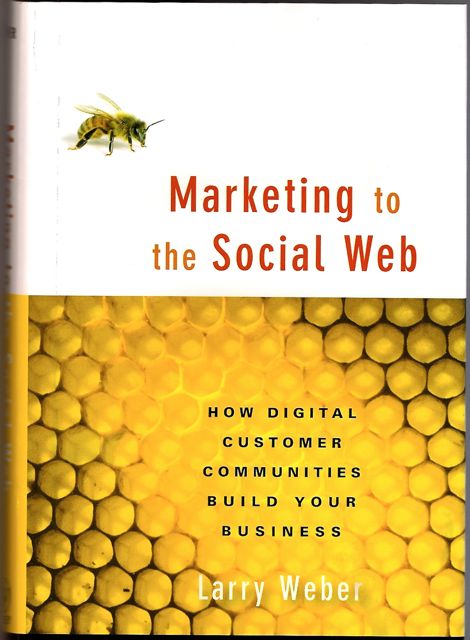
Book Review – Marketing to the Social Web by Larry Weber

Marketing and selling over the Web has been a required activity for almost every business I have been involved in for over ten years. In the last couple of years, the web has continued to evolve and now in some undeniably novel ways. The most notable are the appearance and enormous growth of “communities” or “social networks”. It is clear that the existing web marketing paradigm that focuses on pay-for-click advertising and search engine optimization (SEO) is being enormously enriched by the opportunities presented by social or community oriented environments. This later change requires real shifts in the approach and objectives for marketing on the web.

Just as I have begun to attempt my own synthesis of these changes, I have come upon Marketing to the Social Web: how digital communities build your business by Larry Weber (John Wiley & Sons, New York 2007). The author has extensive experience in the Web world and provides more than enough examples and anecdotes to illustrate his case.

The basic argument of the book is that the interactivity of the web is now producing completely new ways in which companies and customers can interact.

Weber develops seven steps to marketing on the social web:

  1. Observe – see where, what and how your customers do in the social web. Check out blogs, conversations, relevant content, etc.
  2. Recruit – enlist core participants who want to talk about your company, its products and services.
  3. Evaluate platforms – which platforms are best to reach your marketing objectives – blogs, reputation aggregators, social networks?
  4. Engage – this is all about developing and maintaining content – user generated and yours.
  5. Measure – develop metrics relevant to the objectives and measure.
  6. Promote – connect with other communities in the web.
  7. Improve.

Weber provides lots of discussion and anecdotes to illustrate each of these seven steps. Then he adds four strategies to expanding the reach of marketing on the social network – (1) SEO, (2) blogs, (3) e-communities, and (4) social networks.

This book is a solid contribution to understanding and participating in the ongoing development of the web world. This is esepcially so for creating a more productive balance between traditional web marketing, pay-for -click advertising and SEO, and the emerging world of the social web.