TED Talk by Tim Brown of IDEO – Why Design Is Big Again

I have not read Tim Brown’s book Change By Design, but this TED talk strikes me as very valuable in itself. I look forward to reading the book which has just been published. The focus on involving end users, rapid prototyping, systems thinking resonates for me. Lean practitioners will find much in common here. It is great to hear a designer talk forthrightly about the ephemeral nature of most design efforts and even alluding to how much design is gratuitous design.


Three Counter-Intuitive Steps to Becoming a More Effective Manager

Become a More Effective Manager – Three Counter-Intuitive Steps

In the world of planning and strategy, there is a truism that too much planning, too much detail, too much analysis, leads to inaction, to a loss of opportunity. Along the same line of observation, in the world of learning to becoming a more effective manager, there can be too much study, too much thinking, too much integration of the many many skills and aptitudes required to become more effective. In both strategy and management skills action is almost always preferable to another round of study. Action bumps you up against the real world and provides the real basis for improving skills and results.

But, that still leaves us with the nagging question as a manager, especially for rookie managers and supervisors, how do I get started?

Based on many years of personal work as a manager and many years coaching managers, here are three steps you can take that will get you into action and guarantee striking results. These results will come in your personal effectiveness and in of the results of the organization you manage.  Remember,  by results, I am referring to the three meanings Drucker defined: (1) direct business results (usually measured in $s); (2) improved organizational culture (values); and (3) development of people. ((see Chapter 2 – What Can I Contribute? in his book The Effective Executive))

1. Stop Answering Questions

If most managers could listen to themselves, the proverbial fly on the wall, for just a few hours, they would discover that they are chronically enabling dependency all around them and undermining whatever formal delegation systems are in place. How is this happening? Just listen and you will hear a stream of questions coming at them followed by answers in response. You are enabling the following the reflexive pattern: ask the expert and be rewarded with answers. Ask the boss, get an answer, and be safe from responsibility for the answers.

If you want to get people to take responsibility and be involved in the business, you can’t go on answering all these questions. They will just go on asking whether they need to or not. And, you are spending an enormous amount of your time, your most valuable resource, to answering all of these questions.

What should a manager do to break this pattern? Continue reading

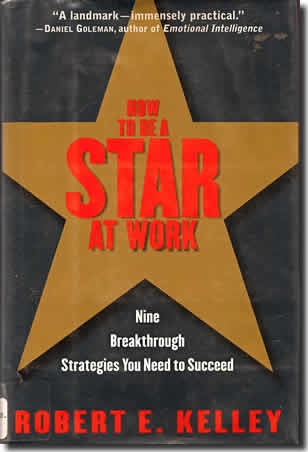
Learning To Be Effective – comments on Kelley’s How To Be a Star At Work

Learning to be an effective manager is almost entirely a self-guided learning enterprise. Almost no business schools even approach the topic despite the hundreds of courses they offer on almost every functional aspect of management ((see Henry Mintzberg, Managers Not MBAs: A Hard Look at the Soft Practice of Managing and Management Development, 1st ed. (Berrett-Koehler Publishers, 2004) for more on this.))

No Significant Differences between Stars and Average in Intelligence, Problem-solving or Technical Skills

So it was with some anticipation that I read through Robert E. Kelley’s  How to Be a Star at Work: 9 Breakthrough Strategies You Need to Succeed (Three Rivers Press, 1999).  This book is based on research at Bell Labs in the 1980s, and 3M a bit later, on the differences between “stars” and average managers.  . Learning to be an effective manager is a multi-disciplinary-multi-modal effort. Clearly an important step is to understand what constitutes the approaches, practices, and skills of an effective manager. How To Be a Star at Work - KelleyBased on work with hundreds of managers, Kelley found that there was no significant difference between “star” and average managers in their raw intelligence, problem solving skills, and technical skill attributes.This may seem surprising until you remember that accomplishing real results in the business world is not a based on individual performance but on the collective efforts of a whole organization. There are almost no significant business problems (or technical ones, too) that can be solved by a single individual. In fact, it is the job of a manager to bring together all of the resources required to achieve real results, focus them on the task and push, pull, inveigle, cajole, lead, or any other verb that describes the persuading that goes on to organize groups in action to achieve real results. Viewed from this perspective it seems less surprising that being a “star” manager has more to do with attributes other than raw intelligence, problem-solving, and technical knowledge.

Better Strategies and Skills in nine areas

What Kelley did find was that the stars has better strategies and skills in nine areas:

  1. Initiative – working the white spaces of the organization
  2. Networking – knowing who knows what in the company’
  3. Self-management – managing your whole life at work
  4. Getting the big picture
  5. Followership – checking your ego at the door and leading in assists
  6. Teamwork
  7. Leadership – doing small-“l” leadership in a big”L”world
  8. Organizational savvy
  9. Show-and-Tell: persuading your audience with the right message

There is some overlap among these nine strategies. For instance Followership, Teamwork, and Small “l” leadership are clearly interdependent ideas. But I do not want to quible here. If you compare this list with the attributes of high performance organizations you will find useful correlations and synergies.

This book is widely available through your local library and from bookstores local and online.

Managing Key Personnel – Do What Is Inevitable – evasion and self-deception will not work

Recently I was speaking with the owner of a financial services firm. She has 15 people in her organization which is now almost 18 years old. By any measure a successful firm.

She told me about one person who has been with the firm for eight years. The owner described this person as the most professional and reliable person in the organization. She performs all sorts of important customer-facing activities flawlessly. This employee is a key person in the organization. The owner went on to tell me about a recent conversation she had with this key person who confided that she did not want to be just an “insurance geek”. She was emphatic about this. The owner told me that this statement jived with other comments this person had made recently. She believed her and felt that her days are numbered.

The owner then went on to describe how she had begun to put together a job manual for all of the key tasks now under the wing of the key employee. This seemed to me to be just the right step. First, the key employee was cooperating in constructing the job manual. This is a great sign of continuing good faith. Second, the owner is testing out the manual to be sure that it really will be a solid platform for training a replacement. Continue reading

What If Agreements – get them in place now, before a what if occurs

Just this morning I heard another tale of woe from a business owner who is now entering into legal disputes because a partner is getting divorced. The business is ten years old, healthy, in fact, holds a strong position in a niche market. But, now the business will be sold or broken into pieces. Several lawyers are also enjoying a feast of fees. 

All of this points back to a fundamental of business formation and business planning – the need for “what if” agreements among the owners.

What if someone dies, becomes disabled, divorced, married, wants to leave the business? How are new partners added? Can a founder be fired? Who owns what and in what form? How will disputes be settled? And, the list of “what ifs” goes on.

So often people start businesses and, in the glow of start up enthusiasms they think, or don’t want to think, about the almost inevitable “what ifs”. They quickly go through setting up the incorporation process and get to work ignoring what will turn out to be all important, the Founders’ Agreement. 

If you are just starting out, make sure that you work through the discussions and legal work for a Founders’ Agreement within the first couple of months. Put your Founders’ Agreement in place. On the other hand, perhaps you have ten years of success in your wake and you still have no Founders’ Agreement (referred to also as Owners’ Operating Agreement and other title). You are living on borrowed time. Get together with your business partners and make it a priority to think through the obvious “what ifs” and then involve your attorneys to formulate an agreement. When one of the “what ifs” occur ,you will be very happy to fall back on its structure.