
Meetings – where you begin to be a more effective manager

A recent New York Times article “Building a Better Teacher” by Elizabeth Green ((March 2, 2010 http://www.nytimes.com/2010/03/07/magazine/07Teachers-t.html)) told the story of Doug Lemov’s discovery that a large component of high performing teachers’ success came from their classroom management skills. While reading the article, and, especially watching the videos of teachers actually employing good class management, I was struck by an interesting parallel in the management world. Just as education schools do not do a good job of preparing teachers to know what to do when they first walk into a classroom, most managers learn their craft by trial and error. They have little help from mentoring or development programs in their companies. And, business schools seem to provide little guidance either.

Meeting management is to effective managers as classroom management is to successful teachers

Meetings are a great place to start to learn the management craft and a crucial platform for driving and sustaining high performance. Great managers and great organizations have great meetings. And, from the perspective of a manager interested in developing a high performance culture, meetings are a great starting point in building a high performance company. After all, meetings exhibit all of the important attributes of high performance organization and culture. And, no effective manager can be ineffective in meetings.

Good meetings:

  • focus on results ($s, people and values)
  • engage, empower and demand every participant’s energies
  • use fact-based thinking
  • orient to customer needs (internal and external)
  • devolve strategy into tactics
  • employ process and systems thinking
  • use well-developed problem solving tools and approaches
  • focus on adding value for customers (internal and external)
  • look for waste reduction
  • build on company and individual strengths
  • among the more important……

Meetings are a great place to start because they are a regular event in which the manager has significant control and can demonstrate, concretely, high performance principles and practices in front of, and with their direct reports.

The Most Significant Reason Business Plans Fail

The failure rate in bringing business plans to fruition is very high. Many observers, including me, have found a number of common failure modes. First among all are the shortcomings in the planning and execution processes themselves. The failure to actually put the plan into action

A good planning process engages all of the significant stakeholders in the creation of the plan. This practice is productive because 90% or more of the facts required to create the plan are sitting in the room when all of the stakeholders are there. Creating the plan through a team effort leverages this knowledge, provides opportunities for problems and opportunities to surface and be resolved, and the resulting plan is inherently owned by everyone because they were present and involved in its creation.

A good planning process insists on ruthlessly testing every assumption. It is a common practice to conduct sessions with no holds bared brainstorming and critiques. This is most essential when planning for a transformation strategy for a mature business. Business leaders find it extremely difficult to prune away the past even when it has no future. Past successes seductively appear to forecast future success.

By far the most significant cause of failure for business plans is the inability of the management to translate the plan effectively into day to day work. Most business plans fall far short of the detailed work required to decompose strategies into tactics. No where do the list of tasks, properly sequenced, appear with clear delineation of responsibility, authority, deliverables, budgets and resources and deadlines. And, finally, there is no clear communications and feedback plan so that those in frontline positions know what to do, why, when, and what are the expected results.

More about why business plans fail over the next four postings

Peter Drucker’s Little Red Book for the General Manager

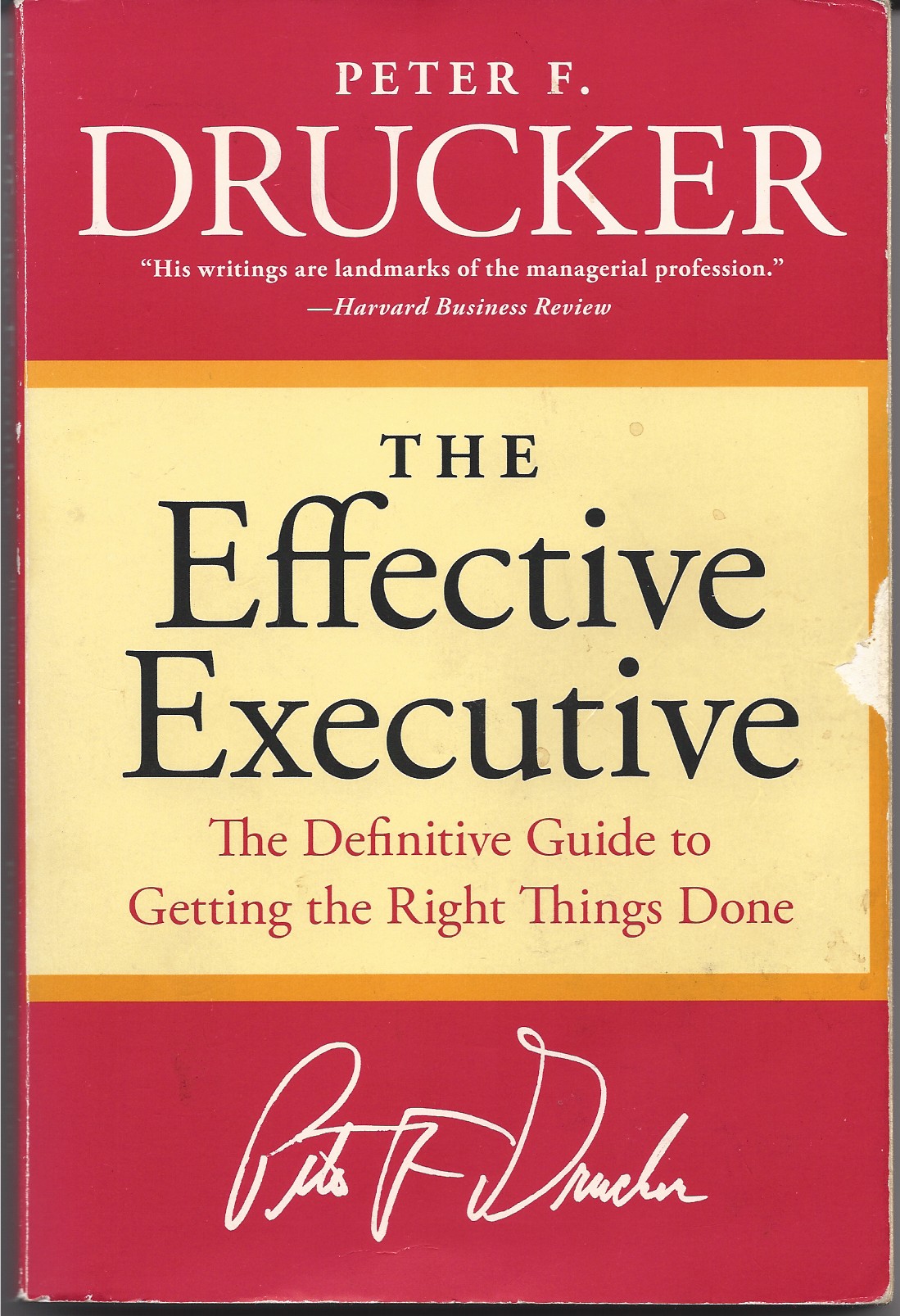
Peter Drucker's The Effective ExecutivePeter Drucker’s The Effective Executive was first published in 1967 and has been in print ever since. I first read it during the 1980s. When I began to coach general managers and owners of small businesses I re-read it with a fresh perspective.

The Effective Executive continues to be a book that I return to for its little pearls of wisdom. Once you get over the now obscure examples from WWII and the 1950s and its dated language (e.g., the pronoun “she” never appears), it remains  a most useful and continuously provocative statement of the tasks of the general manager.

Here are a few quotes for illustration.

  • “In every area of effectiveness within an organization, one feeds the opportunities and starves the problems.”
  • “…the more an executive works at making strengths productive, the more he will become conscious of the need to concentrate human strengths available to him on major opportunities. This is the only way to get results.”
  • “No one has much difficulty getting rid of the total failures. They liquidate themselves. Yesterday’s successes, however, always linger on long beyond their productive life. Even more dangerous are the activities which should do well and which, for some reason or other, do not produce. These tend to become… “investments in managerial ego” and sacred.”
  • “Systematic sloughing off of the old is the one and only way to force the new.”
  • “…no decision has been made unless carrying it out in specific steps has become someone’s work assignment and responsibility. Until then, there are only good intentions.”
Find this little book (183 pages long), read it. You will be enriched.

Managers – Take Responsibility for Employees – Look in the Mirror

Whenever I hear a manager talk about personnel in a complaining tone that focuses on their lack of motivation, sloppiness, and all the other shortcomings that managers so frequently speak or or think about, I am reminded of a central fact about business. ((this actually applies to any organization where there is a hierarchy, non-profits, education, government, and more)) Continue reading

Leadership – “bringing people around softly” and speaking last

The other day I was talking with a business owner about her people management practices. In comparing some thoughts about how to effectively supervise people she noted that waving your finger and giving instructions was almost always a non-starter. She said that she thought that “people need to be brought around softly”. Continue reading

Seize Your Time – step away from “managing” time towards seizing your time

I have written earlier about the strangeness of the concept of “time management” (( in my posting, “Time Management – is now the time to get beyond this distracting oxymoron?”)), but I continue to bump into elements of the vast industry of time management consulting ((I am hardly the only person to note the fallacy of “time management”,here is David E. Allen of Getting Things Done fame on this point)).  And clients continue to wrestle with how to use their time more effectively.  All of this means that I am continuing to sharpen my practices. Continue reading