
Recently I was talking with two clients (partners in an engineering firm) about meetings. In particular were the meetings that one of their customers was calling on short notice with no formal purpose with a cast of thousands. We were puzzling through the various ways they could handle customers who think that it is alright to have meetings that take up lots of time and only really involve my clients occasionally for their input and expertise.
Category Archives: Personal Skills
Do You Meet with Your Staff Regularly? – make these meetings more productive
A recent article in the New York Times business section, “You’re the Boss: the art of running a small business”, by Paul Downs, “The Comment That Changed My Business” spoke of this owner’s experience with holding weekly meetings with his employees. In the 24 year history of this company, they had never held regular employee meetings. Mr. Downs reported on how successful these now are for him.
His story reminded me of my own experiences with meetings. Here is one that is germane to Mr. Downs’ story.
I used Stand Up Meetings for staff. Continue reading
A Silent Client Is Not Necessarily a Happy Client
Are You Holding Silent Clients in Contempt?
Do you think that a client who patiently waits for you to get work done for them without complaining is a happy client? In a world with lots of squeaky wheels and more demands than can be met, we treat the silent client with some contempt. In practice we may let their work slip further and further behind. Our thought processes seem to say, “Well, if they think this is important or urgent, they will let me know.” But this is willfully ignoring the facts about silent clients.
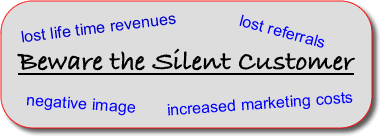 Many people do not like confrontation or conflict. They avoid complaining, or even appearing to be demanding. But, they are not necessarily happy with your service and they do not forget. Few people are masochists. The next time they need your services they will very likely be off to another provider who they hope will be more responsive and honest with them.
Now You Have Lost a Client and Finding the Replacement is Ten Times the Cost of Keeping One You Have Continue reading
Old Technology Displaces New Technology
In a recent coaching session, a long-time client expressed frustrations at keeping track of all of his day-to-day tasks, especially the little items of following through with people he had met. He felt that lots of useful new and old contacts were languishing because he had not followed up on items brought up during a discussion or emails. They are falling through the cracks.
So, I asked him, “How do you keep track of your daily work?” “Well, I still have a Palm Pilot in working order. I enter stuff there.” Clearly this was not working. We kicked around different ways of keeping a task list up to date. Then, I recalled how I solved this same problem for over twenty years. I kept notebooks that I carried around with me and entered notes and tasks chronologically page after page. Knowing that my client was old enough to predate PDAs and other such devices, I asked him whether he had ever used notebooks. “Of course. I kept everything in notebooks. Each was carefully dated and then filed away when every task in it had been completed.” I shared my memories of using notebooks. Even odd moments when a co-worker would come to me to ask what i recalled of a meeting that had taken place months earlier and I dragged out my notebook form that period and found the pages with my notes of the meeting.
My client agreed to try out a notebook as a way of attacking his current problem. There is something very satisfying about putting an arrow in the left column indicating a task or date to be reserved and then, later,putting big check mark next to it with a date when a task is accomplished.
Shortly after wards, it came to me that I was not doing all that well my task list technology (Google Tasks in the calendar), so I have returned to this device that served me so well for so long.
Proven Checklist for Business Success – How Do You Put Them Into Action?
I receive a regular email titled, “Management Intelligence…… from Edward de Bono and Robert Heller” ((http://www.thinkingmanagers.com/)) . Their most recent email was “Management Intelligence: A proven checklist for business success”. Here is the checklist they provided:
“DO YOU…
- IMPROVE basic, measured efficiencies continuously?
- THINK simply and directly about what you are doing and why?
- BEHAVE towards others as you wish them to behave towards you?
- EVALUATE each business and business opportunity with total, fact-based objectivity?
- CONCENTRATE on what you do well?
- ASK questions ceaselessly about performance, markets and objectives?
- MAKE MONEY- knowing that, if you don’t, you can’t make anything else?
- ECONOMISE always seeking Limo (Least Input for Most Output)?
- FLATTEN the organisation to spread authority and responsibility?
- ADMIT to your own failings and shortcomings and correct them?
- SHARE the benefits of success with all those who helped to achieve it?
- TIGHTEN up the organisation wherever and whenever you can because familiarity breeds slackness?
- ENABLE everybody to optimise their individual and group contribution?
- SERVE your customers with all their requirements to standards of perceived excellence in quality?
- TRANSFORM performance by innovating creatively in products and processes including the processes of management?
Again from this email concerning this list: “These questions penetrate to the heart of successful management. They have passed, and will pass, the test of time.
This list looks a lot like others I have seen, and certainly many entries would be on such a list that I might create. But, whenever I see lists like this, I say to myself, “Great, but how do I do this?” Lets just take number 15, for example, “Transform performance by innovating….”. What business processes do I put in place that assure that these results are regularly and sustainably produced? Or, what approaches and tools do I deploy to achieve number 8, “Economize…” ? Again, are there tools and approaches available that assure the we meet number 13, “ENABLE everybody to optimize their individual and group contribution?” Continue reading